
Why Trust This Guide: CV vs resume international organizations
This guide is informed by reviewing 200+ successful applications to the United Nations, World Bank Group, African Development Bank, and African Union, combined with direct input from hiring managers at international organizations who shared what they actually read—and what they ignore.
Key Takeaways: CV vs resume international organizations
- For international organizations, the CV is almost always required—not a resume.
- A UN CV must include nationality, date of birth, and language proficiency levels.
- The World Bank uses its own online application system—a separate PDF is rarely sufficient.
- Length matters differently: 2 pages for private sector, 4-6 pages for UN/development sector.
- Quantified achievements outperform duty descriptions at every level of international recruitment.
Why This Distinction Costs African Professionals Real Opportunities
Every year, highly qualified Ethiopians, Kenyans, and Nigerians submit expertly formatted two-page resumes to the United Nations—and get screened out automatically. Not because their experience is weak. Because they submitted the wrong document type with the wrong structure.
Understanding the difference between a CV and a resume is not academic trivia. In the international job market, it is the difference between being seen and being discarded.
The Core Difference: CV vs resume international organizations
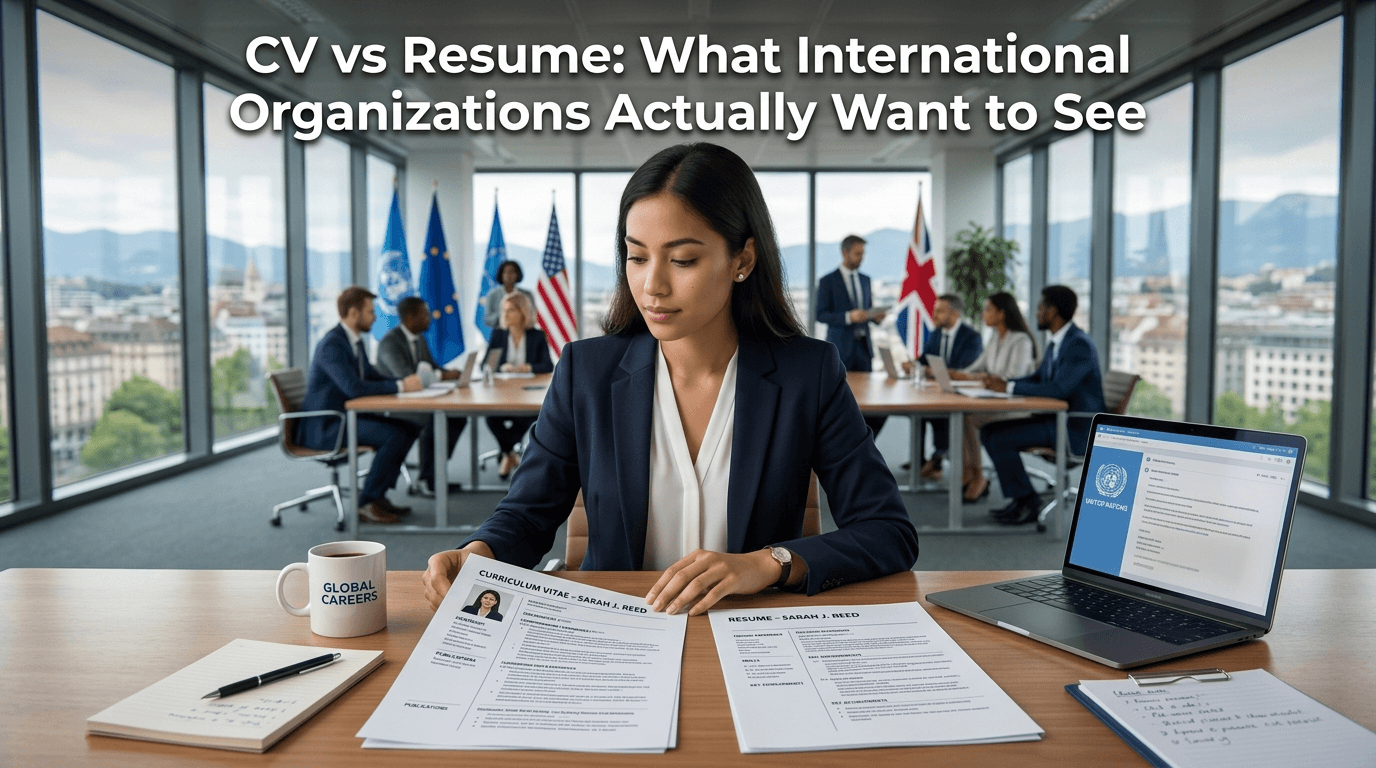
- CV (Curriculum Vitae): A comprehensive document covering your full professional and academic history. No length limit. Standard in academia, international organizations, government, and European job markets.
- Resume: A targeted, concise document—typically 1–2 pages—tailored for a specific private sector role. Standard in the United States and Canada for corporate positions.
Rule of thumb: If you are applying to the UN, World Bank, African Union, UNDP, WHO, African Development Bank, or any bilateral development agency—use a CV. Full stop.
What the United Nations Actually Wants to See
The UN has specific recruitment standards across all agencies. Here is what their HR teams are looking for in your application:
Personal Information (Required—Not Optional)
- Full legal name
- Date of birth
- Nationality (required for all UN positions due to geographic distribution policies)
- Contact information: email, phone with country code
Note: Many Western career advisors will tell you to remove date of birth and nationality from a resume. This is correct for private sector applications—but fatal for UN applications where these fields are mandatory in the Inspira portal.
Education
- List in reverse chronological order
- Include institution, degree title, field of study, year of completion, and country
- Include relevant certifications and training programs
Professional Experience
This is where most applications fail. The UN wants to see:
- Exact job titles and organizational names (with full acronym spelled out on first mention)
- Dates of employment in month/year format
- Number of staff supervised (if applicable)
- Budget managed (if applicable)
- Measurable results—numbers, percentages, beneficiary counts
Languages
The UN uses a standardized proficiency scale: Mother tongue, Fluent, Working Knowledge, and Knowledge. Overestimating language skills is a serious integrity issue—you may be tested. Be precise.
What the World Bank Group Actually Uses
The World Bank recruitment process is largely digital. The external careers portal (jobs.worldbank.org) has its own structured application form. Your uploaded CV supplements—it does not replace—the online form.
For World Bank applications specifically:
- Use a clean, ATS-compatible format (no tables, no graphics, no columns)
- Align your experience descriptions directly with the language in the job posting
- Emphasize development impact: countries served, project budgets, policy influence
- Include publications, working papers, or technical reports for economist/analyst roles
What the African Union Requires
The African Union posts positions on its e-recruitment portal. Unlike the UN, the AU does not have a standardized global CV template—but experienced AU recruiters consistently look for:
- Regional development experience specifically within Africa
- Language skills across AU working languages (Arabic, English, French, Portuguese, Swahili, Spanish)
- Demonstrated knowledge of the AU agenda (Agenda 2063, Silencing the Guns)
- Previous experience in multilateral or intergovernmental settings
Universal Formatting Rules for International Organization Applications
- Length: 3–6 pages is standard for professionals with 5+ years of experience. Junior professionals: 2–3 pages.
- Font: Arial, Calibri, or Times New Roman at 10–12pt. No decorative fonts.
- Format: PDF only unless the portal specifies Word. Ensure the file is searchable text, not a scan.
- No photos: Unless specifically requested, do not include a photograph.
- No graphics or infographics: ATS systems cannot parse images. Charts and icons = lost data.
- Quantify everything: "Managed a team" becomes "Managed a 12-person team delivering $4M in development projects."
The Common Mistakes That Kill International Applications
- Using a two-page private-sector resume for a UN application
- Omitting the nationality and date of birth fields required by Inspira (UN system)
- Using relative language: "helped with", "involved in", "assisted" — these are weak and vague
- Listing duties instead of achievements: what you were responsible for vs what you actually produced
- Submitting a file that has not been proofread in its final PDF format
People Also Ask about CV vs resume international organizations
Does the UN accept a resume instead of a CV?
No. The UN Inspira system requires specific profile fields that function as a structured CV. A private-sector-style two-page resume will be incomplete and may disqualify your application at the initial screening stage.
How long should a CV be for the African Development Bank?
For professional and managerial positions at the African Development Bank, a CV of 3–5 pages is appropriate. For senior leadership or principal-level roles, 5–7 pages covering an extensive project history is acceptable.
What is the biggest CV mistake for international organization applicants?
Describing your job responsibilities instead of your measurable achievements. Recruiters already know what a program officer does. They want to know what your program officer role produced—in numbers, outcomes, and impact.
Getting Your CV Right
Your CV is your first impression with an organization that may receive 500 applications for a single post. The investment in getting it right—ideally through professional review—is one of the highest-return steps you can take in an international career search.
Strive Consultancy Hub offers CV and resume review services specifically calibrated to UN, AU, World Bank, and development sector standards.
Read Related Content:
How to Get a Study Visa for Europe: Country-by-Country Guide