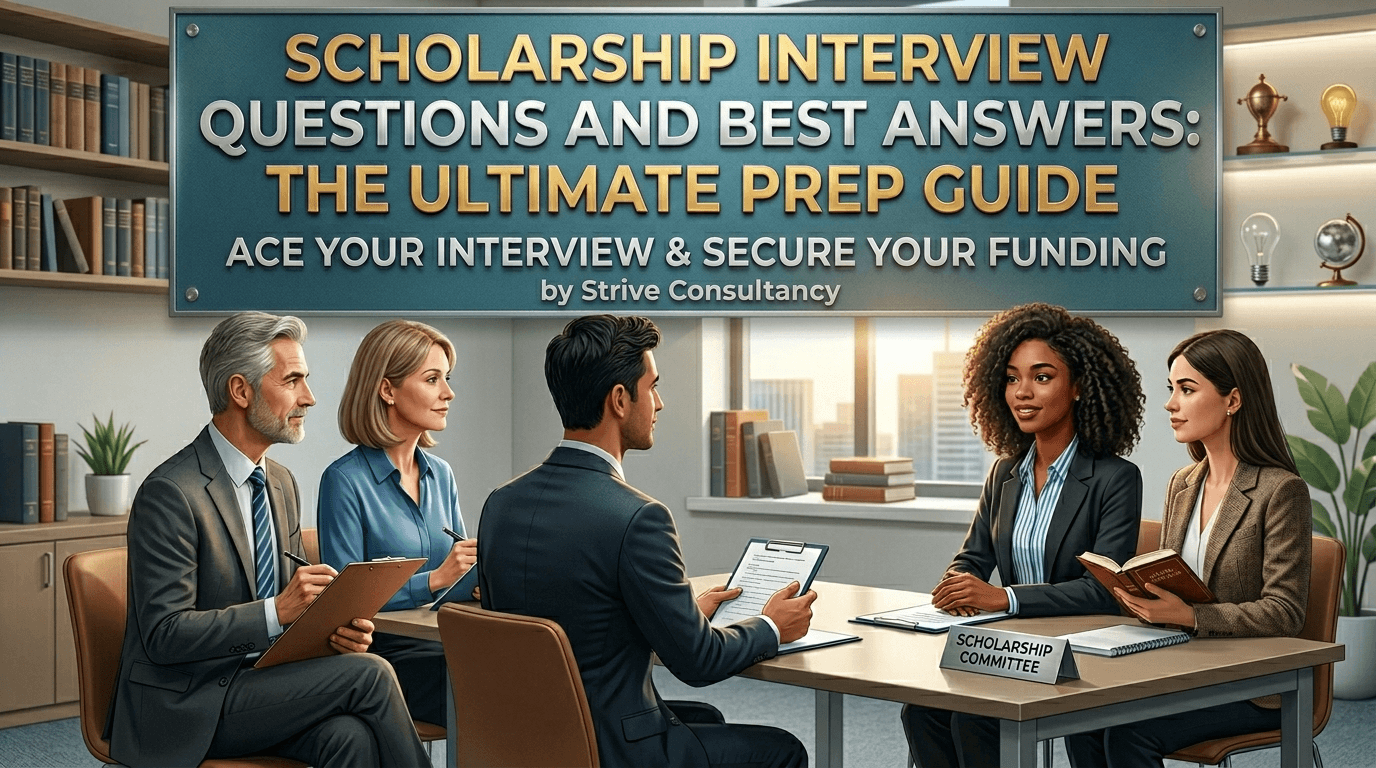

Securing an invitation to a scholarship interview means your academic achievements and transcripts have already done their job. You are officially a top-tier candidate. However, the interview is when the committee evaluates your character, vision, and alignment with their institutional values. To transform that interview into a confirmed funding offer, you must articulate your story with precision, clarity, and purpose.
This comprehensive guide breaks down the most common scholarship interview questions and answers, providing you with plug-and-play frameworks, actionable strategy tips, and expert-vetted examples designed to help you stand out from the competition.
Key Takeaways: scholarship interview questions and answers
- Do Your Homework: Align your answers directly with the funding organization's core mission, values, and history.
- Be Structured: Use the STAR Framework (Situation, Task, Action, Result) to keep your situational answers concise and outcome-oriented.
- Show Your ROI: Treat the scholarship as an investment. Prove to the committee that funding your education will yield long-term benefits for your community or field.
- Own Your Story: Authenticity beats a rehearsed, "perfect" answer every time. Highlight genuine growth over flawless, mistake-free histories.
Scholarship interview questions and answers: Why Trust Our Interview Frameworks?
At Strive Consultancy, our academic advisors have spent over a decade guiding students through elite international funding tracks, including Fulbright, Chevening, and specialized institutional fellowships. We analyze committee feedback trends year-over-year to reverse-engineer what winning candidates do differently. This guide bypasses generic advice to offer high-authority, field-tested communication strategies that convert panels into sponsors.
Icebreaker & Personal Background Questions
The opening minutes of your interview set the psychological tone for the entire session. Committees use these questions to gauge your communication style, confidence, and baseline self-awareness.
1. "Tell me about yourself."
This is not an invitation to read your resume chronologically. It is a strategic pitch to highlight the exact experiences that make you an ideal fit for this specific award.
- The Winning Strategy: Use the Present-Past-Future formula. Briefly state where you are now academically or professionally, highlight a key past milestone that shaped your trajectory, and conclude with how this scholarship enables your immediate future.
- LSI Alignment: Tell me about yourself scholarship sample
Standard vs. Expert Answer Analysis
- Weak Answer: "My name is Alex. I’m a biochemistry major from Chicago. I love science, and I play soccer. I’m applying for this scholarship because college is expensive and I need help with tuition."
- High-Authority Answer:
"I am currently a senior biochemistry student focusing on cellular mutations. My passion for research started two years ago when I spearheaded an undergraduate lab project analyzing water toxicity levels in rural communities—an experience that resulted in our team presenting at an international symposium. Moving forward, my goal is to transition into genetic epidemiology to develop scalable public health solutions. This scholarship acts as the critical bridge, allowing me to focus entirely on advanced laboratory research during my master's degree without financial constraints."
2. "What are your greatest strengths and weaknesses?"
Committees ask this to evaluate your self-awareness, emotional intelligence, and resilience.
- For Strengths: Avoid vague buzzwords like "hard worker" or "perfectionist." Choose a data-backed attribute (e.g., resourcefulness, analytical synthesis) and pair it with a brief proof point.
- For Weaknesses: Never offer a disguised strength (e.g., "I work too hard"). Instead, share a genuine professional or academic limitation that you are actively managing with a structured solution.
Best Practice Framework
- Strength Answer: "My greatest strength is my project-based resourcefulness. During my junior year, when our departmental research budget was cut by 40%, I independently audited open-source data alternatives and re-routed our methodology, ensuring our milestone deliverables were met three weeks ahead of schedule."
- Weakness Answer: "In the past, I struggled with public speaking, occasionally letting nerves overshadow my data presentation. Recognizing this as a barrier to my leadership goals, I joined an academic Toastmasters chapter last semester and actively volunteered to present our lab's weekly updates. While I am still refining my delivery, my presentation confidence has improved substantially."
Deep Dive into Core Institutional Value Questions
Scholarships are investments in human capital. The committee wants to ensure that your values map neatly onto their organization’s foundational mission.
3. "Why do you deserve this scholarship?"
This question causes many candidates to stumble because it requires a balance of humility and absolute confidence.
- The Mistake: Focusing entirely on your financial need or your past grades.
- The Strategy: Reframe the question. You deserve the scholarship because you are uniquely positioned to execute the mission of the scholarship fund. Show them the return on investment (ROI) they will get by backing you.
- LSI Alignment: Why do you deserve this scholarship answer
[Candidate's Unique Skills & Vision] +[Organization's Mission & Philanthropic Goals] =[High-Impact Community / Global Outcomes]High-Authority Sample Answer
"I deserve this scholarship because my academic track record is directly matched by a proven commitment to executing your foundation's core mission: expanding digital literacy in underserved areas. Over the past two years, I have not only maintained a 3.9 GPA in Computer Science, but I have also founded a weekend coding camp that has trained 45 local youth.
By investing in my education, you are not simply funding a degree; you are backing a validated vehicle for community empowerment. I have the technical baseline, the organizational experience, and the cultural context to scale these educational initiatives to a national level upon graduation."
4. "Why did you choose this specific university/program?"
Generic praise about a university's ranking or reputation signals a lack of depth. You must prove that you have thoroughly audited their curriculum.
- Action Plan: Mention specific professors whose research aligns with yours, unique laboratory assets, distinct course modules, or institutional partnerships that only that university provides.
Expert Execution
"My decision to pursue the MSc in Environmental Policy at this institution is driven by Dr. Elena Vance’s ongoing research into urban grid sustainability. Her methodology directly complements my undergraduate thesis on localized solar microgrids. Furthermore, your program’s mandatory dual-semester practicum offers unparalleled exposure to municipal policymaking, providing me with the practical framework necessary to bridge the gap between clean-energy theory and regulatory execution."
Situational & Leadership Questions (The STAR Method)
To predict your future success, committees look closely at your past behavior. Behavioral questions should always be structured using the STAR Method to ensure zero fluff and maximum impact.
S - Situation: Set the scene concisely (1-2 sentences).T - Task: Explain the challenge or goal you faced.A - Action: Detail the specific steps YOU took to address it.R - Result: Highlight the quantifiable, positive outcome.5. "Describe a time you overcame a major challenge or failure."
The committee is looking for psychological resilience, problem-solving capabilities, and lateral thinking.
STAR Framework Example
- Situation: "During my sophomore year, I was leading an interdisciplinary team of five students for a regional social entrepreneurship competition."
- Task: "Two weeks before our final pitch presentation, our primary data collector abruptly left the program due to personal reasons, taking our core market validation metrics with them."
- Action: "Instead of panicking, I quickly reassigned roles based on team strengths. I scheduled an emergency data sprint, leveraged open-source demographic databases, and personally spent 15 hours re-running our statistical analysis models to ensure our numbers were completely accurate."
- Result: "Not only did we deliver our presentation on time, but our revised methodology was specifically praised by the judging panel, ultimately securing us second place out of forty competing universities."
6. "Where do you see yourself in five to ten years?"
Committees want to fund visionaries, not passengers. Your long-term goals must look ambitious yet remain grounded in a realistic professional trajectory.
- Key Focus: Connect your immediate academic pursuits directly to systemic, high-level industry contributions.
High-Authority Sample Answer
"In five years, I plan to complete my doctoral research in developmental economics, focusing on agricultural supply chain optimizations in Sub-Saharan Africa. Professionally, I aim to work as a Senior Policy Advisor for an international body like the World Bank or the African Development Bank.
Ten years out, my goal is to lead an independent research institute that designs data-driven agricultural frameworks for regional governments, directly reducing post-harvest losses for smallholder farmers and building long-term food security."
People Also Ask: scholarship interview questions and answers
How do you handle stress during an academic program?
"I manage academic pressure through aggressive time block scheduling and maintaining clear boundaries between deep intellectual focus and physical wellness. When deadlines converge, I break complex projects into micro-deliverables using project management frameworks like Kanban. This prevents cognitive overload and ensures steady, high-quality output without burning out."
What should I wear to a scholarship interview?
"You should wear professional business attire. For men, this means a well-fitted suit with a conservative tie and polished dress shoes. For women, a tailored pantsuit, a structured blazer, or a formal professional dress is ideal. Your appearance should project respect for the committee and the high-value nature of the award."
What questions should I ask the scholarship committee at the end?
Always prepare two to three highly customized questions for the panel. Excellent options include:
- "What common traits have you observed in the most successful alumni of this scholarship program?"
- "How does your foundation envision its role evolving within this specific academic field over the next five years?"
- "Are there mentorship opportunities or alumni networks that scholars can plug into during their first year of study?"
Final Day Checklist: scholarship interview questions and answers
Preparation extends right up to the moment you log into your virtual portal or walk through the committee's door. Use this practical blueprint to ensure you are firing on all cylinders:
- Review Your Application: Re-read your statement of purpose, essays, and resume. The committee will pull specific strings from your file to test your consistency.
- Audit Your Tech: For virtual sessions, check your lighting, run an internet speed test, test your microphone audio, and ensure your background is clean and professional.
- Analyze the News: Scan recent global headlines, breakthrough research papers, or policy changes affecting your chosen field. Showing contextual awareness sets you apart as a mature candidate.
- Body Language: Maintain strong eye contact, sit up straight, and remember to smile naturally. Confidence is communicated non-verbally long before you finish your opening sentence.
By mastering these frameworks and avoiding the trap of generic, canned responses, you shift the interview narrative. You cease to be a student asking for financial assistance and become an obvious, low-risk, high-return asset for the scholarship committee's portfolio.
Read Related Content:
How to Apply for a Fully Funded Scholarship: Step-by-Step Guide for Africans