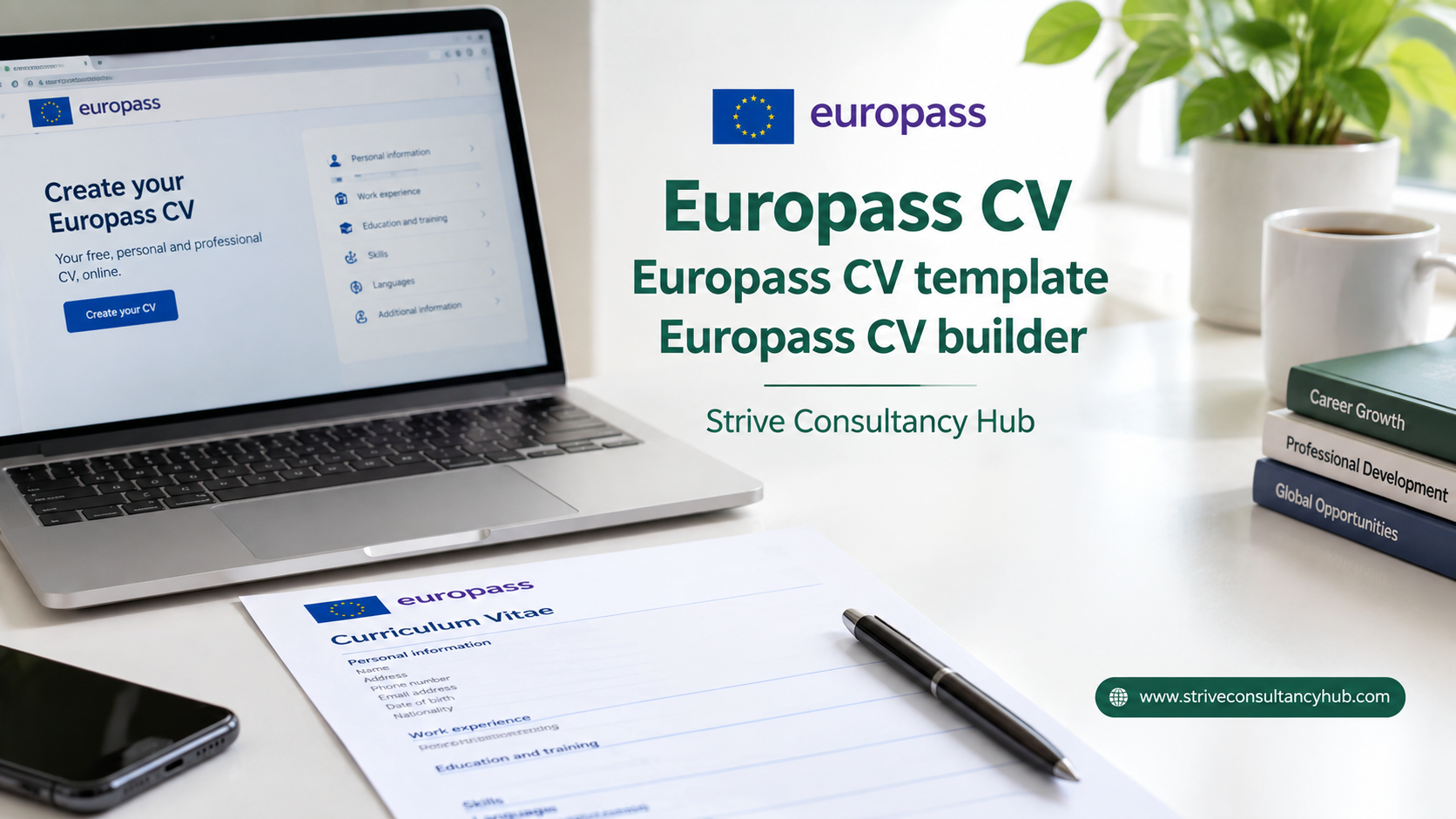

If you're applying for a job, internship, or study programme anywhere in the EU or EEA, there's a good chance an employer or university will ask for a Europass CV. In short: it's a free, standardised curriculum vitae format built by the European Union so a hiring manager in Warsaw can understand your qualifications as easily as one in Rome. You build it on the official Europass CV builder, fill in four core sections — personal details, work experience, education, and skills — and export it as a PDF or Word file in minutes.
Here's the catch nobody mentions: the rigid structure that makes the Europass CV readable everywhere is the same structure that can flatten your personality into a template recruiters skim past in six seconds. This guide from Strive Consultancy Hub's career advisors breaks down exactly when the Europass format works in your favour, when it works against you, and how to fill it in so it doesn't read like everyone else's.
Key Takeaways
- The Europass CV is a free, EU-standardised format — best for public-sector, government, and academic applications across Europe.
- It's built and hosted only on the official europa.eu Europass portal; you don't need to pay for a template.
- Every version needs four sections: personal information, work experience, education and training, and personal skills.
- Rated language skills (CEFR A1–C2) and a specific target occupation are the two fields most applicants get wrong.
- For private-sector or creative roles, a modern branded resume usually outperforms the Europass format.
What Is a Europass CV, and Do You Actually Need One?
The Europass CV is one part of the wider Europass framework, an EU initiative that also includes a cover letter editor, a skills passport, and tools for comparing qualifications across member states. Unlike a resume you design from scratch, every Europass CV follows the same four-part skeleton — and that's the point: it removes formatting ambiguity for recruiters comparing candidates from different countries and education systems.
When the Europass Format Helps
- Applying to public-sector jobs, EU institutions, or government-funded programmes in Europe
- Going through Erasmus+, study-abroad, or exchange programme applications
- Submitting to universities or training providers that explicitly request the Europass format
- Applying in a country where you don't speak the local language fluently — the standard layout reduces translation friction
When to Skip It
- Applying to private companies, startups, or creative industries, where a modern, branded resume usually performs better
- Roles where you want to highlight portfolio work, metrics, or personality the rigid template can't showcase
- Applications in the UK, US, or non-European markets, where Europass is largely unrecognised
As of 2026, most private employers outside government and academic channels don't specifically request Europass — but plenty still accept it, and some public-facing portals require it as the only upload format. Always check the job posting before defaulting to it.
How to Create a Europass CV in 2026 (Step-by-Step)
You can build your CV two ways: directly on the official Europass portal, or by downloading a Word template and filling it in offline. The portal method is faster and auto-formats everything, so we recommend it for most applicants.
- Create a free Europass profile at the official portal (link below). One profile lets you generate unlimited CVs in different languages.
- Add your personal details — name, address, phone number with country code, and email. A professional photo is optional, not mandatory.
- State your target occupation. This single field tells both the system and the recruiter what role you're positioning yourself for — don't leave it generic.
- List work experience in reverse-chronological order. Use exact dates and start each bullet with an action verb.
- Add education and training, including certifications, licences, and Erasmus or exchange credits if relevant.
- Fill in language skills using the CEFR scale (A1–C2) — this is the section most applicants under-detail, and it's often the first thing international recruiters check.
- List digital, communication, and other personal competences. Be specific — “project management software (Asana, Trello)” outperforms “good with computers.”
- Preview, proofread, and export as PDF or an editable Word/ODT file.
Europass CV Structure: The Four Sections Every Recruiter Expects
Regardless of any extras you add, every Europass CV needs these four building blocks:
- Personal Information — contact details, nationality (optional), and target role
- Work Experience — job title, employer, dates, and 2–4 bullet points of concrete responsibilities and results
- Education and Training — degrees, institutions, dates, and relevant coursework or thesis titles
- Personal Skills — languages (CEFR-rated), digital skills, communication and organisational skills, and driving licence if relevant
Optional sections — volunteering, projects, publications, awards — are where you actually differentiate yourself, so don't skip them just because they're marked optional.
5 Mistakes That Sink an Otherwise Good Europass CV
Having reviewed hundreds of Europass CVs for clients applying to EU roles and study programmes, our advisors at Strive Consultancy Hub see the same five errors on repeat:
- Treating “Personal Skills” as filler. Generic phrases like “team player” read as unverified. Recruiters scanning dozens of Europass CVs a day skip past vague language instantly.
- Leaving the target occupation field blank or too broad. “Looking for opportunities” tells a recruiter nothing. Name the actual role.
- Ignoring the language proficiency scale. Self-rating your English as “fluent” without a CEFR level (B2, C1) reads as unverified — back it up with a test score if you have one.
- Uploading it as the only document. A Europass CV plus a short, tailored cover letter consistently outperforms a Europass CV alone: the CV proves qualification, the letter proves motivation.
- Never re-exporting after edits. We've repeatedly seen candidates submit CVs with outdated job titles because they updated the online profile but forgot to download the current version.
Fixing just the first two mistakes typically moves a CV from “screened out by keyword filters” to “shortlisted for review” — it's a formatting exercise, not a content overhaul.
Europass CV vs. Modern CV: Which Should You Use in 2026?
| Situation | Better Choice |
| EU institution, government body, or university application | Europass CV |
| Private company, startup, or creative role | Modern branded resume |
| Job posting explicitly requests Europass | Europass CV |
| You want to showcase a portfolio or design skills | Modern resume + portfolio link |
Many candidates now keep both — a Europass CV on file for institutional applications, and a designed resume for everything else. That's the approach we recommend to clients: build once, tailor per application.
Why Trust This Guide
Strive Consultancy Hub works directly with students and professionals navigating European job and study applications, which means our advisors track Europass portal updates, application outcomes, and recruiter feedback as part of daily practice, not a one-off research exercise. This guide reflects the current 2026 version of the Europass platform and is revised whenever the EU changes the tool's structure or requirements. We link only to the official europa.eu Europass portal for the CV builder itself, so you're never filling out a third-party clone of the official form.
People Also Ask
Is the Europass CV still used in 2026?
Yes. It remains standard for EU-funded programmes, many universities, and public-sector roles, though private employers increasingly accept modern formats too.
Is the Europass CV free?
Yes — it's completely free to create, edit, and download through the official Europass portal.
How long should a Europass CV be?
One to two pages. Add optional sections only when they add relevant value, not to fill space.
Do I need a photo on my Europass CV?
No. A photo is optional, and in many EU countries omitting it is now standard practice to reduce unconscious bias in screening.
Can I use a Europass CV outside Europe?
You can, but it's rarely recognised outside the EU/EEA and Western Balkans, so a locally standard resume format usually performs better for non-European applications.
Final Verdict
If your target is European, government-linked, or academic, the Europass CV is still worth building — it's free, fast, and occasionally mandatory. Just don't let the template do all the work: the candidates our advisors see get shortlisted are the ones who fill in every field with specific, verifiable detail rather than generic phrasing.
Ready to build yours?
Create your Europass CV now on the official EU portal →
Read Related Content: Documents Required for Scholarship Application: The Complete Checklist