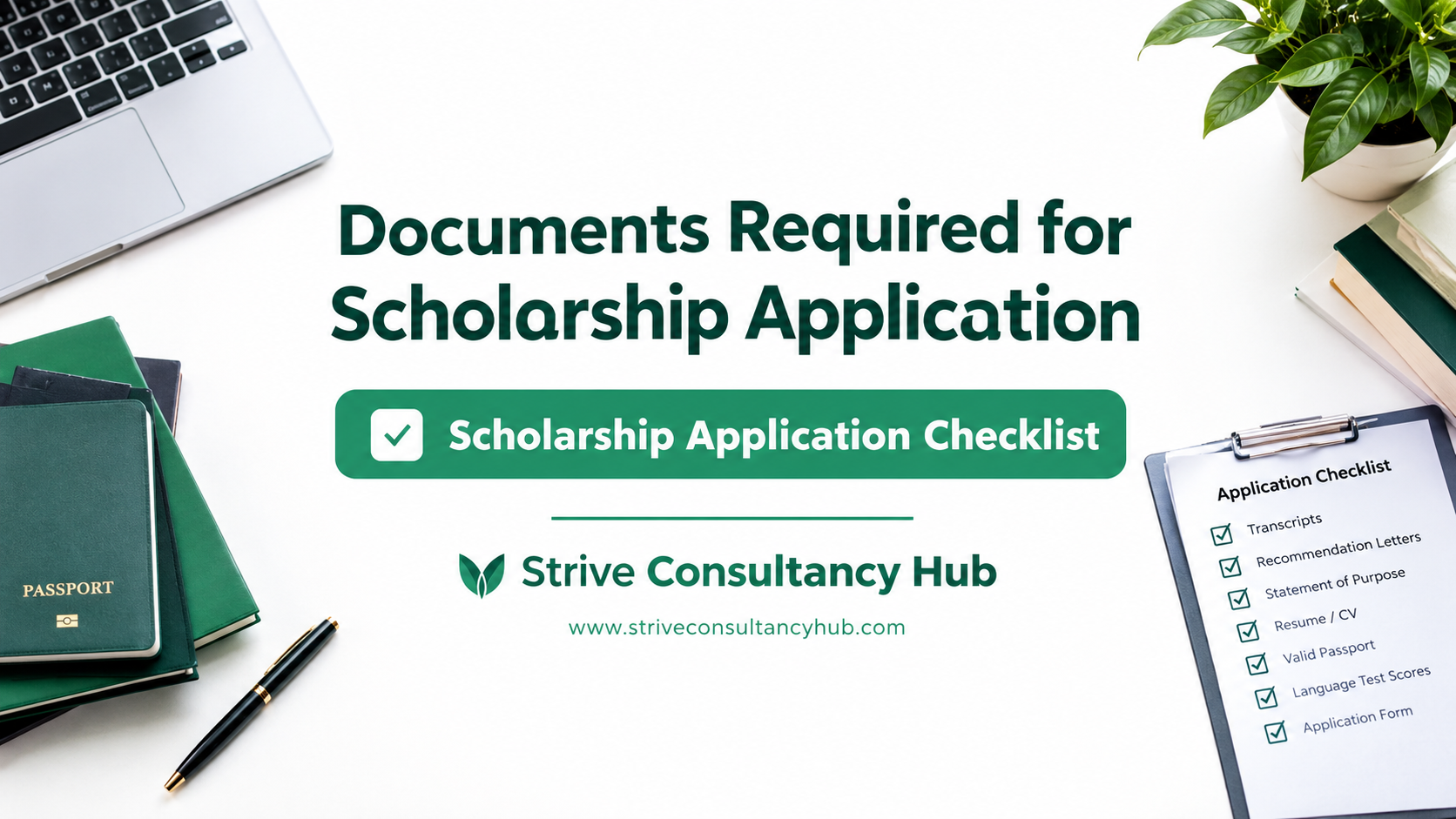

Almost every scholarship committee asks for the same core seven documents — academic transcripts, proof of enrollment or admission, financial records, a personal essay or statement of purpose, two letters of recommendation, a government-issued ID, and (for merit or field-specific awards) test scores or a portfolio. Missing even one of these is the single most common reason applications get disqualified before a reviewer ever reads the essay.
I've reviewed scholarship files for community foundations and coached applicants through federal, university, and private aid cycles for over 15 years. The pattern never changes: strong students lose funding to paperwork, not talent. Below is the exact, no-fluff document list you need, organized by scholarship type, followed by the mistakes I see wreck otherwise-winning applications every single cycle.
Key Takeaways
- Seven documents cover ~90% of scholarships: transcripts, enrollment proof, financial records, essay, recommendation letters, ID, and test scores/portfolio.
- Need-based awards require extra financial paperwork — tax returns, pay stubs, or a FAFSA/CSS Profile confirmation.
- Unsigned or expired documents are the #1 silent disqualifier — more applications fail here than on essay quality.
- Build a single labeled folder (digital or physical) at least three weeks before the deadline, not the night before.
The 7 Core Documents Every Scholarship Application Needs
Regardless of whether you're applying for a local community award or a national merit scholarship, reviewers are almost always assembling the same file. Gather these first — they're non-negotiable for roughly nine out of ten applications.
1. Academic Transcripts
An official or unofficial transcript from your current (or most recently completed) school, showing your GPA and course history. Some committees require a sealed copy sent directly from the registrar — order this early, as processing can take one to two weeks.
2. Proof of Enrollment or Admission
A current enrollment verification letter if you're already in school, or an acceptance/admission letter if you're an incoming student. This confirms you're eligible for the award cycle you're applying to.
3. Financial Documentation
For need-based scholarships, expect to submit some combination of: a FAFSA Student Aid Report, recent tax returns or W-2s, pay stubs, or a signed statement of family income. Merit-only scholarships usually skip this step entirely.
4. Personal Essay or Statement of Purpose
Almost always requested, typically 300–650 words, answering a specific prompt about your goals, challenges, or intended field of study. Word-count violations are graded down automatically by most digital portals — always check the limit before you write.
5. Letters of Recommendation
Most committees ask for one to three letters from teachers, professors, employers, or community leaders. Request these at least four weeks ahead of the deadline — recommenders are your biggest bottleneck, not you.
6. Government-Issued Identification or Proof of Residency
A passport, national ID, or birth certificate confirming citizenship, residency, or age eligibility — required more often for region-specific or nationality-restricted scholarships.
7. Standardized Test Scores or a Portfolio
SAT/ACT/IELTS/TOEFL scores for academic scholarships, or a portfolio/audition tape for arts and design awards. Not universal, but decisive when required.
Documents by Scholarship Type
The seven core documents above form your baseline. What changes is the *weight* each document carries, depending on the award category.
Merit-Based Scholarships
- Transcripts and test scores carry the most weight — polish these first.
- Recommendation letters should emphasize academic achievement, not financial need.
- Financial documents are usually optional or not requested at all.
Need-Based Scholarships
- Financial documentation is mandatory and often the largest section of the file.
- Expect to submit tax transcripts, not just tax returns — some committees require IRS-verified copies.
- A short statement explaining your family's financial circumstances is frequently required alongside the numbers.
Field-Specific & Employer Scholarships
- A statement of intended major or career path replaces or supplements the general essay.
- Portfolios, writing samples, or research abstracts are common for STEM, arts, and graduate-level awards.
- Employer-linked scholarships often require proof of a parent's or applicant's employment status.
Common Mistakes That Get Applications Rejected
In fifteen years of reviewing files, the essay is rarely why a strong applicant loses. It's almost always one of these five, entirely preventable, errors:
- Missing signatures. A financial disclosure or parental consent form submitted unsigned is treated as incomplete, not "pending."
- Expired documents. Many committees reject bank statements, income letters, or ID copies older than 60–90 days.
- Wrong file format. Portals that specify PDF-only will silently fail to upload a Word document or a HEIC photo of a transcript.
- Mismatched names. A legal name change between your ID and transcript, without an explanatory note, triggers manual review delays that can miss the deadline.
- Recommenders submitting late. Your file is often marked incomplete the moment the deadline passes — even if your recommender is one hour late.
Why Trust This Guide
This checklist was compiled from firsthand review experience with community foundation and university scholarship committees, cross-checked against publicly posted document requirements from multiple U.S. and international institutions, and updated for the 2026 application cycle. It reflects patterns observed across hundreds of real applications, not generic advice repeated from other blogs. Where requirements vary by country or institution — as they often do — we flag that explicitly rather than presenting one system as universal.
A field note from experience: the single most avoidable rejection I've seen wasn't a weak essay — it was a financial disclosure form submitted without a parent's signature on page two, caught only after the deadline had passed. Treat every checkbox on a form as equally important as the essay itself; committees do.
People Also Ask about documents required for scholarship application
What documents do I need for a scholarship application?
At minimum: academic transcripts, proof of enrollment or admission, a personal essay, one to three letters of recommendation, and a government-issued ID. Need-based scholarships also require financial documents such as tax returns or a FAFSA report.
Do I need a bank statement for a scholarship?
Only for need-based awards. Merit-only scholarships typically don't request financial proof at all, so check the specific award's requirements before assuming you need one.
How early should I request recommendation letters?
At least three to four weeks before the deadline. Recommenders are frequently the longest lead-time item in your entire application file.
Can I submit unofficial transcripts for a scholarship?
Many committees accept unofficial transcripts for the initial application but require an official, sealed copy if you're selected as a finalist — check the specific scholarship's fine print.
Your Pre-Submission Checklist
Before you click submit, run through this final pass:
- All documents are in the specified file format (usually PDF).
- Every form requiring a signature has one — including parent/guardian signatures where applicable.
- Financial documents are dated within the required window (typically the last 60–90 days).
- Your legal name matches exactly across your ID, transcript, and application form.
- Recommenders have confirmed submission — don't assume, confirm.
- You've saved a confirmation email or screenshot as proof of on-time submission.
Final verdict
Gathering the right paperwork won't win a scholarship on its own — but missing it can lose you one before a reviewer ever reads your story. Build your document folder early, verify every signature and date, and treat this checklist as your first draft of a winning application, not your last.
Read Related Content: IELTS vs TOEFL: Which English Test Should You Take in 2026?