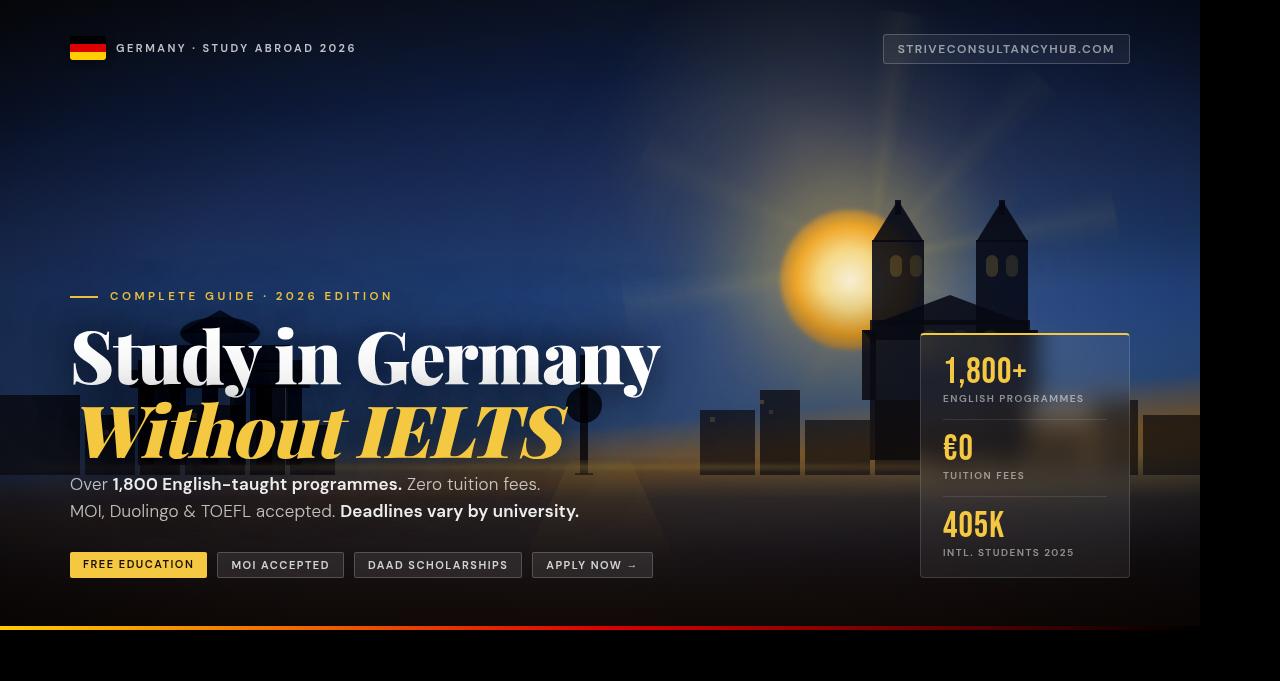

Key Takeaways: Study in Germany without IELTS 2026
- IELTS is NOT mandatory to study in Germany in 2026.
- Over 1,800 English-taught degree programmes exist at German public universities.
- Alternatives accepted: MOI certificate, Duolingo English Test, TOEFL, PTE, Cambridge.
- Most public universities charge ZERO tuition — only a semester contribution of €200–€400.
- Application deadlines vary by university — Winter 2026 intake ranges from April to July. Always check your target university's official admissions page.
- DAAD, Friedrich Ebert, and Heinrich Böll Foundation scholarships are available without IELTS.
If IELTS has been the one barrier standing between you and a world-class European education, here is the truth: Germany does not require IELTS to study there. Not in 2026. Not for thousands of international students who are right now enrolled in top-ranked German universities — tuition-free.
Germany has quietly become one of the most pragmatic and student-friendly study destinations on the planet. The German government has granted universities the autonomy to decide their own English proficiency requirements, and a significant majority have lifted mandatory IELTS scores in favour of more accessible alternatives. The result? A pathway to a globally respected degree that is more open — and more affordable — than ever.
This guide from Strive Consultancy Hub gives you every detail you need: which universities accept you without IELTS, what documents replace it, scholarship opportunities, application deadlines, and a direct link to apply. No filler. Just facts.
Why Trust This Guide?
Strive Consultancy Hub has supported hundreds of students in securing admissions to European universities since 2015. Our team includes certified educational counsellors with direct experience navigating German university portals, Uni-Assist applications, and APS procedures for international applicants. Every claim in this article is sourced from official university admissions pages, DAAD (German Academic Exchange Service) data, and verified 2026 intake information. We update this guide every semester.
Is IELTS Actually Required to Study in Germany in 2026?
The short answer: No. IELTS is not compulsory for German universities. Germany is not an English-speaking country, which means English language tests like IELTS do not hold the same institutional weight here that they do for UK or Australian admissions.
What German universities require is proof that you can function academically in the language of your chosen programme. If that programme is in English, you need to demonstrate English proficiency — but IELTS is only one of many ways to do so.
If your programme is taught in German, you will instead need TestDaF Level 4 or DSH Level 2 — Germany's recognised German language certifications. For English-taught programmes, read on.
What Replaces IELTS? Accepted Alternatives in 2026
- Medium of Instruction (MOI) Certificate —The most widely accepted alternative. Issued by your previous institution, it confirms that your education was delivered entirely in English. Free to obtain and carries full weight with most German universities and the German Embassy for visa applications.
- Duolingo English Test (DET) —Now almost universally accepted across Germany in 2026. It costs far less than IELTS, can be taken from home, and delivers results in 48 hours. A score of 100+ is typically required.
- TOEFL iBT —Widely recognised. A score of 80–90 is standard for most master's programmes.
- PTE (Pearson Test of English) —Accepted by most public universities and often preferred for its fast turnaround.
- Cambridge C1 Advanced or C2 Proficiency —Accepted by some research-intensive universities.
- English-Medium Bachelor's Degree —If you completed your undergraduate degree entirely in English, many German universities will waive any further language test entirely.
- Digital Interview (Fachhochschulen) —Many Universities of Applied Sciences in 2026 will conduct a 15-minute Zoom or Teams interview. Communicating your academic goals clearly is sufficient to waive the formal test requirement.
Top German Universities That Accept You Without IELTS (2026 List)
The following institutions are among the most popular destinations for international students applying without an IELTS score. Always verify programme-specific requirements on the official university portal before applying.
| University | IELTS Alternative Accepted | Tuition Fees |
| TU Munich (QS #22) | MOI, TOEFL, PTE, Cambridge | €0 (+ €144 semester fee) |
| RWTH Aachen (QS #105) | MOI, TOEFL, PTE, Duolingo | €0 (+ ~€300 semester fee) |
| University of Stuttgart | MOI, TOEFL, PTE | €0 (+ ~€200 semester fee) |
| TU Berlin | MOI, TOEFL, Duolingo | €0 (+ ~€300 semester fee) |
| University of Hamburg | MOI, Duolingo, internal test | €0 (+ ~€350 semester fee) |
| University of Mannheim | MOI, TOEFL, PTE, Cambridge | €0 (+ ~€200 semester fee) |
| Heidelberg University | MOI, TOEFL, PTE | €0 (+ ~€180 semester fee) |
| Free University Berlin | MOI, TOEFL, Duolingo | €0 (+ ~€314 semester fee) |
| Univ. of Koblenz-Landau | MOI, internal English test | €0 (+ ~€280 semester fee) |
| Univ. of Kaiserslautern | MOI, internal English test | €0 (+ ~€250 semester fee) |
General Eligibility Requirements for Study in Germany without IELTS 2026
Even without IELTS, German universities maintain rigorous academic standards. Here is what you generally need to be eligible:
- Academic Qualification:A recognised secondary school certificate (for undergraduate) or a bachelor's degree (for master's). Indian students completing 10+2 typically need to complete a Studienkolleg (foundation year) for direct undergraduate entry.
- APS Certificate:Mandatory for applicants from India, China, and Vietnam. The Academic Evaluation Centre (APS) verifies your academic documents before you can apply. Budget 6–8 weeks for this process.
- Language Proof (as above):MOI certificate, TOEFL, PTE, Duolingo, or English-medium degree.
- Statement of Purpose (SOP):A focused, well-written motivation letter explaining your academic goals and why Germany.
- CV (Europass format):Standard for all German university applications.
- Letters of Recommendation (LORs):Typically, two academic references.
- Transcripts and Degree Certificates:Officially attested and translated into German or English.
- Passport Copy:Valid for at least 12 months beyond your intended start date.
Application Deadlines — Winter 2026 Intake (Vary by University)
This is one of the most critical things to get right: German university deadlines are not uniform. Each institution — and often each programme within the same institution — sets its own application window. The table below gives a general guide, but you must always confirm on the official university page before submitting.
| 2026 DEADLINE GUIDE — Deadlines Vary by University |
| TU Munich (MSc programmes, direct portal): 31 May 2026 — verify at tum.de |
| TU Munich (undergraduate via Uni-Assist): 15 July 2026 — verify at tum.de |
| RWTH Aachen: Varies by programme — check apply.rwth-aachen.de directly |
| LMU Munich: Varies by programme — check lmu.de/admissions directly |
| Most Uni-Assist universities (Winter intake): Typically April–July — always confirm on uni-assist.de |
| Summer Intake 2027 (limited availability): Applications typically open Oct–Dec 2026 |
| APS Certificate (India/China/Vietnam applicants): Allow 6–8 weeks — start immediately |
| Visa Application (after receiving offer letter): Allow at least 3–4 months before the semester start |
| ALWAYS verify the exact deadline on the official university admissions page — deadlines change each intake cycle. |
Pro Tip:Uni-Assist recommends submitting at least 8 weeks before your programme's stated deadline. Some programmes at popular universities fill up well before the official closing date. Start your application at least 4–6 months before your intended semester start.
Scholarships Available Without IELTS (2026)
Germany's scholarship ecosystem is robust. The following major funding bodies do not specifically require IELTS as part of their scholarship criteria:
1. DAAD (German Academic Exchange Service) Scholarships
DAAD is Germany's most prestigious scholarship provider. The DAAD International Postgraduate Scholarship supports master's and PhD students across all disciplines. Awards typically cover tuition (where applicable), a monthly stipend of €850–€1,200, health insurance, and travel costs. Language requirements are set per programme and often accept TOEFL or MOI certificates.
2. Friedrich Ebert Foundation Scholarship
Awarded to academically gifted students with a demonstrated commitment to social and democratic values. Covers living expenses, study materials, and health insurance. No IELTS requirement — university admission letter with language proof is sufficient.
3. Heinrich Böll Foundation Scholarship
Focuses on students with strong ecological and human rights values. Open to both German and international students at the undergraduate, master's, and doctoral levels. Accepts MOI and alternative English proficiency proof.
4. Erasmus+ Programme
For students from EU partner institution countries, Erasmus+ provides mobility grants covering travel, housing, and living expenses. Language requirements mirror the host university's, meaning IELTS alternatives are accepted wherever the host university accepts them.
Step-by-Step Application Process: Study in Germany without IELTS 2026
- Step 1 — Check Programme Requirements:Visit the official university admissions page or uni-assist.de. Confirm whether your chosen programme accepts MOI or your preferred alternative.
- Step 2 — Obtain Your MOI Certificate:Request an official Medium of Instruction certificate from your previous institution's registrar. Ensure it is stamped, signed, and explicitly states English as the language of instruction.
- Step 3 — Complete APS Verification (if required):India, China, and Vietnam applicants must submit to APS. Start this process immediately — it takes 6–8 weeks.
- Step 4 — Prepare Your Documents:Assemble transcripts, degree certificates, SOP, CV (Europass format), two LORs, passport copy, and MOI/language test certificate.
- Step 5 — Apply via Uni-Assist or Directly:Most public universities use Uni-Assist (uni-assist.de). TU Munich, LMU Munich, and Heidelberg use direct portals. Pay the Uni-Assist processing fee: €75 for the first application, €30 for each additional.
- Step 6 — Receive Offer Letter and Apply for Visa:Once admitted, use your offer letter and MOI certificate (or alternative) to apply for a German student visa at your nearest German embassy or consulate.
- Step 7 — Arrange Finances and Travel:Open a blocked account with at least €11,208 (required for visa). Most public universities charge only a semester contribution of €200–€400, often including a regional transport pass.
Apply Now:Submit your application via Uni-Assist (Official Portal) | TU Munich Direct Application | DAAD Scholarship Portal
People Also Ask: Study in Germany without IELTS 2026
Can I get a German student visa without IELTS?
Yes. If your German university has admitted you using an MOI certificate or an accepted alternative test, the German Embassy will process your student visa based on those documents. There is no separate IELTS requirement imposed by the visa process.
Is a MOI certificate enough to study in Germany?
For the majority of English-taught master's programmes at German public universities, yes — a properly issued MOI certificate from your accredited institution is sufficient. However, always confirm with the specific programme, as requirements vary.
Can I study in Germany for free without IELTS?
Yes. Most German public universities charge zero tuition fees for international students. You will only pay a semester contribution (usually €200–€400), which frequently includes a public transport pass for the city or region. Combine this with a DAAD scholarship, and your cost of study drops to near zero.
What is the minimum score for Duolingo to study in Germany?
Most German universities accepting the Duolingo English Test require a score of 100–110. Some highly competitive research programmes may set the threshold higher. Check the exact requirement on your programme's admissions page.
| READY TO APPLY? STRIVE CONSULTANCY HUB CAN HELP |
| Free 1-on-1 counselling session with a certified Germany admissions expert. |
| We prepare your MOI request letter, SOP, and Uni-Assist application. |
| 97% visa success rate for our Germany-bound students. |
| Strive Consultancy Hub — turning study-abroad ambitions into accepted offers. |
Read Related Content:
Study in Sweden without IELTS 2026: Top Universities, Scholarships & How to Apply
Contact here:Contact Strive Consultancy Hub for a Free Consultation
Disclaimer: Application requirements and deadlines are subject to change. Always verify with the official university portal or Uni-Assist before submitting. Information current as of June 2026.
© 2026 Strive Consultancy Hub | striveconsultancyhub.com